


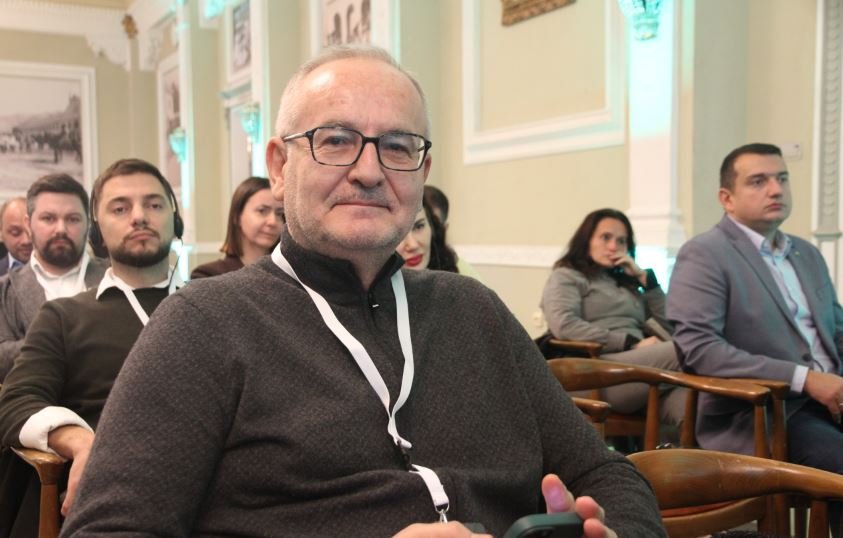




Brussels and Washington seem to have no interest at all to see a glaring difference in what the authorities in Podgorica are doing, as if they are only interested in what the authorities are saying, writes Darko Šuković.
Darko Šuković is the chief editor of Antena M, media partner of EUalive in Montenegro.
Montenegro is the last republic of the former Yugoslavia to become an independent state. At the referendum held on 21 May 2006, 55.5% of citizens voted for independence. Apart from regaining the statehood of the country which once was the old kingdom, and only South Slavic country that preserved its freedom during the rule of the Ottoman Empire over most of the Balkans, the referendum, for the first time in history, shown that the majority of Montenegrin citizens are pro-Western oriented. It was clear support for the program of the political entities that advocated an independent Montenegro, with membership in the EU and NATO put forward as key foreign policy goals.
The pro-western majority in Montenegro was built with a number of obstacles and relatively slowly. Historical heritage and dominant collective sentiment for centuries have bound the smallest and oldest South Slavic state to Russia, as a Slavic and Orthodox hub. Resistance for the regaining of independence on the referendum was strong – proved by 44.5% of votes against, and supported by Serbia: politically, financially, with media and intelligence. Even in the USA and the EU, especially at the beginning, there was no enthusiasm for the idea of Montenegro as a sovereign state. Luckily, those years Russia had other priorities and projections and did not focus on events in Montenegro.
However, ten years later, on the eve of joining NATO, the situation changed significantly. Russia was openly against Montenegro’s membership in the Alliance, so, using anti-Western structures in Serbia and Montenegro, the Kremlin (through GRU) tried to topple the government of Milo Đukanović and prevent membership in the key general elections in October 2016. The attempt of coup was thwarted, a number of the conspirators were prosecuted and sentenced in the first court ruling, with the key evidence provided by Western intelligence. The horrific scenario had been confirmed by Serbian President, Aleksandar Vučić.
However, the widespread belief that Montenegro, by joining NATO, had definitively escaped from the clutches of Russia and became part of the Western civilization, turned out to be wrong and it was demonstrated in the election process on 30 August 2020. The electoral victory was achieved by the coalition established of the pro-Prussian and pro-Serbian parties, led by the Democratic Front of Andrija Mandić and Milan Knežević (in the first court ruling, each sentenced to five years prison for involvement in the coup attempt; soon after the election, the verdict was annulled and the prosecutor who led the case has been in custody ever since – for 18 months already) and with the Democrats of Aleksa Bečić. In fact, this political force would stay in the minority even on the basis of that election results as well. But they were enabled to take the power via support of the civic URA movement (United Reform Action) of Dritan Abazović (whose brother is probably the only ethnic Albanian who successfully develops business in Belgrade) who managed to attract 5% of predominantly sovereigntists voters, dissatisfied with the old long-ruling government led by Đukanović’s DPS (Democratic Party of Socialist).
The paradox that the state power was gained by politicians who were against the very existence of an independent Montenegro is not the only one. By their actions as well as inactions, the EU and the US have enabled Belgrade and Moscow to brutally interfere in these (and all subsequent that followed) elections and allowed the pawns of Aleksandar Vučić and Vladimir Putin to come to power instead of genuinely pro-Western parties and politicians.
The fact that the first government (of prime minister Zdravko Krivokapić) was agreed in the Monastery of Ostrog controlled by the Church of Serbia/ Serbian Orthodox Church (SPC) testifies to the character of all 3 Montenegrin governments that dominated and currently holding power ever since 30 August 2020, in various forms. This powerful religious organization, actually, is also the most powerful political entity in Montenegro, and dealing with religion is its secondary business, as the implementation of the long-standing national project of the Serbian world/Greater Serbia is its primary task. The Church of Serbia/SPC is the most loyal ally of the Moscow Patriarchate/Russian Church. For the bishops (metropolitans) of the Church of Serbia, NATO is the “Fourth Reich”, the European Union is a “dungeon of nations” that smells of “the stench of Sodom”, Montenegrins are “communist scum”, Bosniaks-Muslims are “false people of the false religion”, and the war crimes convicted Ratko Mladić and Radovan Karadžić are “Serbian heroes”. For five years, Montenegro has been governed by political subjects who hold and promote the quoted values or those who accept to be in a coalition with them.
As crazy as it may seem, in the very same government Brussels and Washington somehow see a reliable NATO partner and key drivers of Montenegro’s path to the EU!? As institutionally, economically and democratically more destroyed Montenegro is, the closer it is to the EU. It seems unreal, but it is also true. The national Montenegrins, who are ethnic majority in numbers, have been practically expelled from institutions in the last five years, exposed to assimilation and the theft of their cultural, especially sacred, heritage. With signing the so-called Fundamental Accord between the then Prime Minister Abazović and Serbian Patriarch Porfirije, all Orthodox temples in Montenegro were handed over to the ownership of a religious organization SPC based in Belgrade. There is a widespread belief within the Montenegrin nationals that their country was awarded to Serbia and Vučić as compensation for Kosovo and as a bait to turn their back from Russia.
All these processes, however, are wrapped in a veneer of pro-European rhetoric. Brussels and Washington seem to have no interest at all to see a glaring difference in what the authorities in Podgorica are doing, as if they are only interested in what the authorities are saying. Thus, the Speaker of the Parliament Andrija Mandić, by far the most powerful politician in Montenegro, who has never renounced the position that Serbia is his motherland and Putin his leader, has become an EU partner in the process of European integration of the country that he, de facto and de jure, governs.
From its side, the EU and US, for five years, by punishing parties that had been in power for 3 decades, are punishing Montenegro, effectively helping the efforts to turn the country into a colony of Serbia. Montenegrin society, under the thin crust of the government’s pro-European narrative, is sinking into clerical chauvinism, while secularism and civic character of the nation are rapidly disappearing.
The sincere pro-Western-oriented part of Montenegrin society, confused at the beginning, and then deeply disappointed by the attitude of “our Western friends”, is switching to electoral abstention or accepting the luring perks and flying over on the side of the government. Support for the EU and NATO is starting to decline and even the government can no longer hide it. Recent messages that the EU must protect itself from accepting new “Trojan horses” signaling that Brussels is perhaps starting to understand what’s happening in Montenegro. But there is no clear admission of mistakes. And there probably won’t be any. The consequences, however, can be easily predicted. Each and every time is the same, when someone turns their back on true friends and tries to make partners out of arch-enemies.
Komentari (0)
POŠALJI KOMENTAR